Welcome! I have some programming challenges for you...
But first! What if you formed a group to undertake one of these challenges, or something else. Perhaps not even a programming challenge!
Ideas about working as a group on a design task.
Reading lines from a text file.
The challenge doesn't lead to a "fun" or "exciting" program... but it will give you practice in writing code to read from a text file. Being able to do that opens the doors to projects which you might find fun or exciting.
Of course, you are not going to make a working CT scanner. But perhaps you could create software to illustrate how a CT scanner works. The page gives you some ideas I hope.
There are two parts to the challenge. I believe it can be achieved. It is in two parts... I can see a 12 year old achieving the first part- capturing images simulating the operation of a CT scanner, and a 16 year old achieving the second- writing the software to turn the captured images into a picture of what the "CT scanner" "saw".
Source code to play with and extend. Or try to do it from scratch!
The sourcecode will show you how to set up a TImage object, and control the color of individual pixels.
Basics! With lots of uses.
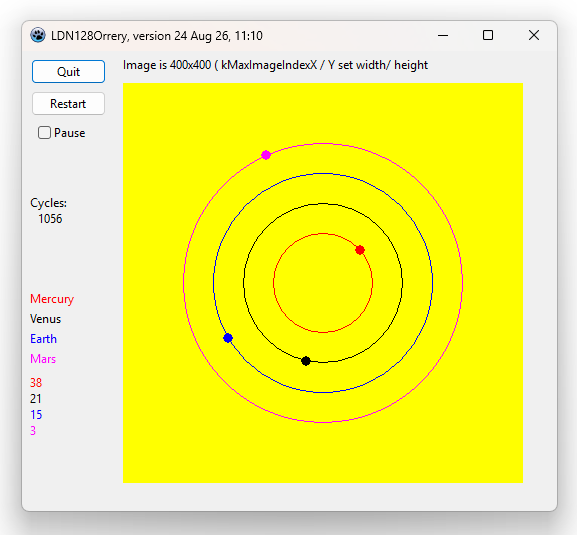
But then the fun begins... getting the dots to spin isn't terribly difficult... but working through what it takes might be rewarding.
I've put together a little challenge if someone wants to "play" with it. (Or set it as homework to some students!). It merely asks you to write a little code to solve a problem. There's lots of help with how to go about it.
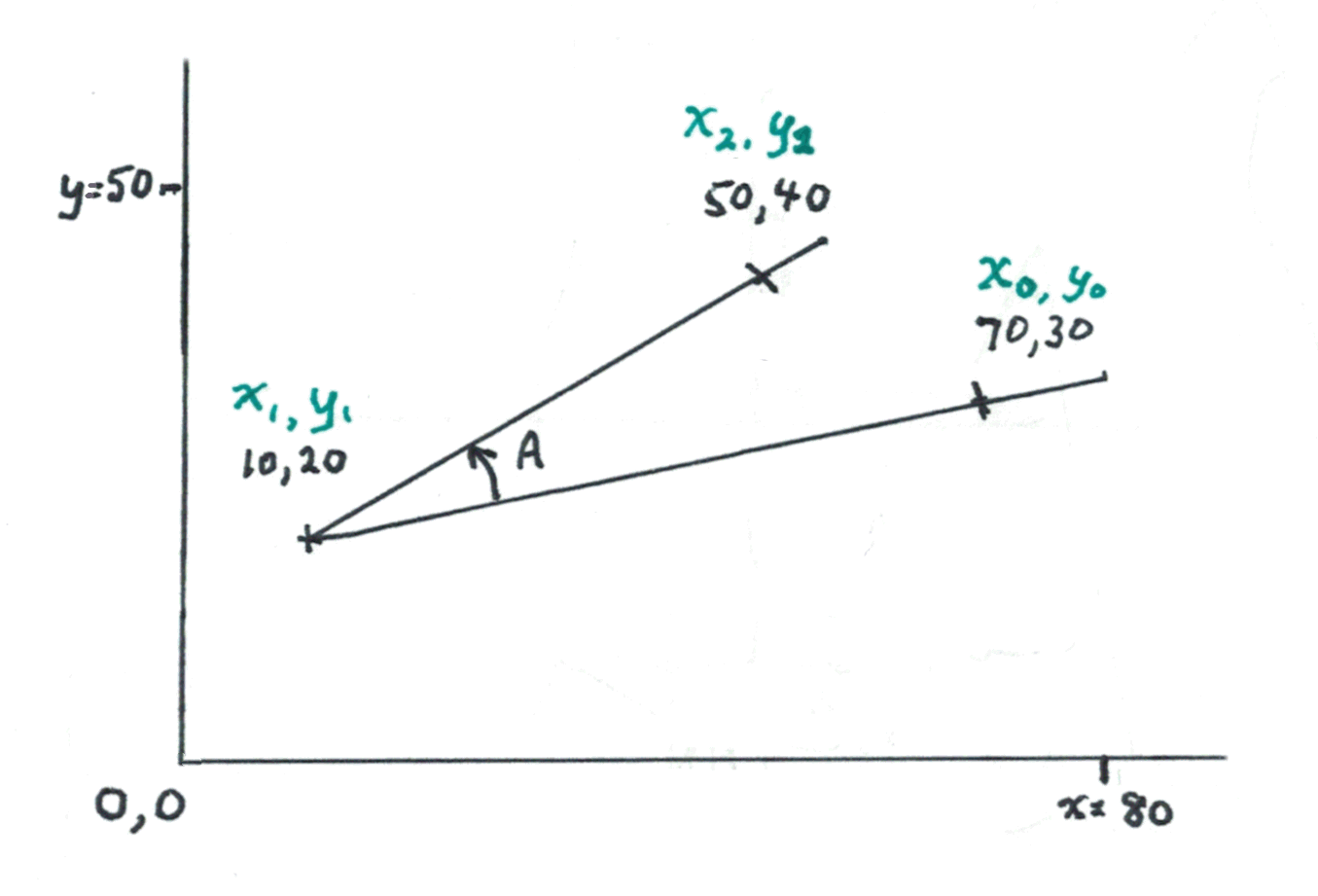
The challenge is to calculate an angle from the x,y coordinates of three points which are assumed to be connected by two line segments defining an angle.
Why would you WANT such a program? It could be the start of a program to draw maps from field data collected by you!... by some friends. (See my https://wywtk.com/fea/sci/maps/ (aka https://bit.ly/MakeMyMap3), where you can learn how to make maps the way it was done before GNSS (the Global Navigation Satellite System)... which is what we usually mean when we say GPS). That page gets a bit over-excited in places. Just skim over them. All you need is a pizza box, a pencil, and two high hills... or even just a bit of open ground, or a gym, to try the ideas out.
You can download the sourcecode of a shell for the program.
Someday I'm going to write up as the challenge of using a computer to turn bearings measured from hills into a map... the basis of all large scale maps until well into my lifetime. (As explained at the site mentioned above.)
This is a "middling-difficult" challenge: Write some of the code it would take to create a program to "read" answer sheets for multiple choice tests and surveys.
It might be a project to be tackled by a group with sub-teams.
This is a huge project. Perhaps it would take a team of programmers working together. But bits of it could be done by an individual.
The challenge is to produce a system in which users would play games or take tests. The system would assess the player's performances, and populate a data base. It would also allow participants to call up displays of their own performance, and the performance of others. It could be used, for instance, to manage a tennis ladder, or evaluate user's fluency with their times tables.
It was inspired by the big displays in the mess hall at Battle School in the book/ film Ender's Game, if you happen to be familiar with that.
I hope the challenges are adequately explained? You are of course free to modify any challenge if you like. They're only here to give you ideas for things you might enjoy attempting.
I would be very happy to mention successful attacks on any challenge here. I'm afraid I won't just post a link to your page. (Too often in the past, people have done something worthy of a link... but then change what's on that page to malware and such. Sigh. But we can find some way to exhibit your creation.) Contact details below.
By all means, also please feel free to use the contact details to make suggestions, ask questions, etc.
I hope schools will find some of these challenges useful for students studying programming.
Search across my sites with a Google search...
This searches wywtk, skywoof, sheepdogguides, sheepdogsoftware and arunet... but doesn't always give all of the pages that have content which matches the criterion.
Use this to search THIS site.... (Go to my other sites, below, and use their search buttons if you want to search them.)
(Alas... my Lazarus material is split across two sites... SheepdogGuides.com and WYWTK.com. Sorry!)
This search engine is "old skool"- it merely looks for the words you type, so....
* Spell them properly.
* Don't bother with "How do I get rich?" That will merely return pages with "how", "do", "I"....
Please also note that I have three other sites, and that this search will not include them. They have their own search buttons.
My WhatYouWantToKnow site- https:/wywtk.com.
My SheepdogSoftware.co.uk site.
http://www.arunet.co.uk/tkboyd/index2.htm: My site at Arunet. (Sorry.. not httpS accessible)
To email this page's editor, Tom Boyd.... Editor's email address. Suggestions welcomed! Please cite "lt8n-chall-index.htm".
 Page has been tested for compliance with INDUSTRY (not MS-only) standards, using the free, publicly accessible validator at validator.w3.org. It passes in some important ways, but still needs work to fully meet HTML 5 expectations. (Copy your page's URL to your clipboard before clicking on the icon, so you can easily paste it into the validator when it has loaded.)-->
AND it has been tested with...

 Why is there a script or hidden graphic on this page? I have my web-traffic monitored for me by eXTReMe tracker. They offer a free tracker. If you want to try one, check out their site. Neither my webpages nor my programs incorporate spyware, but if the page has Google tools, they also involve scripts. Why do I mention the scripts? Be sure you know all you need to about spyware.
-- Page ends --